The Anxious Generation: How the Great Rewiring of Childhood Is Creating an Epidemic of Mental Illness
by Jonathan Haidt
The shift from play-based to phone-based childhood (2010-2015) displaced essential developmental experiences, causing a mental health crisis. We over-protected children in the real world while under-protecting them in the virtual world—and we can reverse it.
Listen
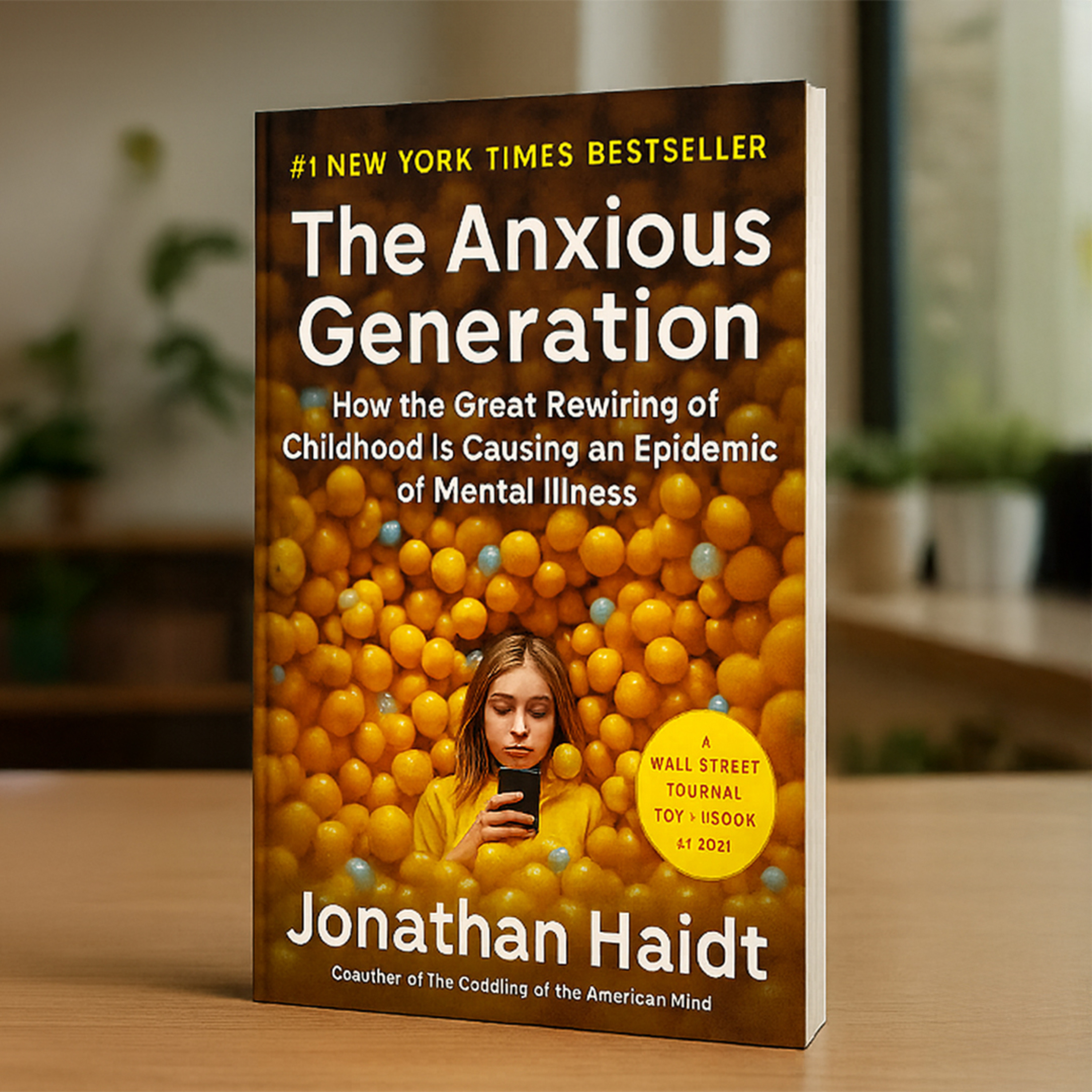
What Happened to Gen Z? - The Anxious Generation by jonathan haidt
Why did rates of anxiety, depression, and self-harm among adolescents skyrocket in the early 2010s? In this episode, we dive into Jonathan Haidt’s The Anxious Generation to uncover the "Great Rewiring" of childhood.We explore how the shift from a play-based childhood to a phone-based childhood has fundamentally altered human development. Tune in to understand the four foundational harms of the digital age and the actionable solutions
Watch on YouTube
Haidt reveals the mystery of 2012: Around this time, adolescent mental health metrics spiked vertically—hospital admissions for self-harm among teenage girls increased by over 100% in just a few years across the US, UK, Canada, and Australia.
Key Insight: This wasn't coincidence. The period 2010-2015 marks "The Great Rewiring of Childhood"—the exact moment when smartphones became ubiquitous (iPhone 4 with front-facing camera) and social networking shifted to algorithmic social media (the "Like" button, retweets, infinite scroll).
🎯 The Two Playgrounds
For all of human history, children experienced a Play-Based Childhood: free play, physical risk, face-to-face conflict resolution. This built "antifragility"—children got stronger when exposed to stressors.
We replaced this with a Phone-Based Childhood: over-protecting in the real world (fearing abduction and injury) while under-protecting in the virtual world (unrestricted access to bullying, pornography, and social comparison).
💡 The Glass Jar Theory
Think of a child's development like a Glass Jar representing their waking hours. In a healthy childhood, you fill it with nutrient-dense rocks: 9 hours of sleep, face-to-face socialization, physical movement, focused attention.
The smartphone acts like thick, grey sludge poured in first. The average teen spends 7-9 hours on screens. This sludge fills the jar so completely that there's no room left for the nutrient rocks—they spill over the side. The harm isn't just what the phone does; it's what the phone pushes out.
🧭 The Four Foundational Harms
- Sleep Deprivation: Blue light and FOMO prevent deep restorative sleep, crucial for puberty.
- Social Deprivation: Texting isn't talking—it lacks non-verbal cues (eye contact, tone, touch) needed to flood the brain with oxytocin and build empathy.
- Attention Fragmentation: Constant notifications break flow state. A child can't learn to think deeply if attention is fractured every 60 seconds.
- Addiction: Dopamine feedback loops engineered by behavioral psychologists to keep children hooked.
🧠 The Collective Action Problem
Many parents feel helpless. They know the phone is harmful, but they feel they cannot take it away because "everyone else has one." If they restrict the phone, they fear their child will be socially isolated.
⚡ The School of Fish Analogy
This is a classic Collective Action Problem, similar to a school of fish swimming toward a dark, dangerous cave (the algorithmic world). An individual fish (a parent or child) might want to turn around and swim toward the light (the real world). But the current of the school is so strong that the individual is dragged into the cave against their will.
"The only way to solve this is not through individual willpower, but through collective action—where the whole school turns together."
📅 The Paradox of Protection
We've created a dangerous paradox: over-protection in the real world (no unsupervised play, no walking to school) while under-protection in the virtual world (unrestricted access to platforms designed to exploit developing brains).
We traded physical bumps for psychological fracture. The "Old Playground" was messy and physical—children fell, scraped knees, learned limits. The "New Playground" is a sterile, padded room where children sit motionless, plugged into devices connecting them to millions of strangers and algorithms designed to keep them engaged.
✨ Key Takeaways
- No Smartphones Before High School
- No Social Media Before 16
- Phone-Free Schools
- More Independence, Free Play, and Responsibility
1. No Smartphones Before High School (Age 14)
Give children "dumb phones" (basic talk/text devices) or watches for communication. They do not need the internet in their pocket during middle school—the most vulnerable developmental period.
This isn't about being anti-technology. It's about timing. The prefrontal cortex—responsible for impulse control and judgment—isn't fully developed until the mid-20s. Middle schoolers need protection from devices designed to exploit their developing brains.
2. No Social Media Before 16
Let them get through the hardest years of puberty without the pressure of algorithmic curation and performance. Social media platforms are designed to maximize engagement through comparison, validation-seeking, and FOMO—exactly what adolescents are most vulnerable to.
"The 'Like' button wasn't designed to connect us—it was designed to keep us scrolling."
3. Phone-Free Schools
This means "bell-to-bell" restrictions. Phones must be locked away in Yondr pouches or lockers for the entire day. Having a phone in the pocket, even on silent, is a distraction—a "brain drain."
- Phones disrupt learning even when not in use—the mere presence creates cognitive load.
- Schools that implement phone-free policies see immediate improvements in academic performance, social interaction, and mental health.
- This requires collective action—individual parents can't solve this alone. Schools must lead.
4. More Independence, Free Play, and Responsibility in the Real World
We must stop over-protecting. Let children walk to school. Let them play unsupervised. Let them manage their own conflicts. We must give them back the "Old Playground".
This isn't about being neglectful—it's about recognizing that children need physical risk, face-to-face conflict resolution, and the opportunity to build antifragility. The real world is far safer than we've been led to believe, and the virtual world is far more dangerous.
The transition to a phone-based childhood was a mistake, but it is not irreversible. By understanding the mechanism of the "Experience Blockers" and solving the "Collective Action Problem," we can reclaim childhood for the next generation. The goal is to unplug them from the matrix and plug them back into the rich, messy, beautiful real world.
"We inadvertently ran a massive, uncontrolled experiment on human development, moving childhood from a 'play-based' existence rooted in the physical world to a 'phone-based' existence rooted in a disembodied virtual world."
Subscribe to Daily Wisdom
One idea, one practice — each morning.
No spam. Unsubscribe anytime.